
The Playbook Company: Rules of the Game for a Business That Wants to Grow Without Going Mad
Processes should protect safety. A playbook should guide the game. An article about why a company often does not need more procedures and workflows, but a shared way of thinking, deciding, communicating and leading people.
Most companies eventually reach a point where they start longing for order.
There are more projects. Customers ask more questions. Salespeople promise things in slightly different ways. New employees keep asking the same questions. Management feels that the same mistakes are happening again and again. And sooner or later, someone at the table says:
“We need a process for this.”
Sometimes they are right. But quite often, this is where the road to a process cage begins.
The company starts drawing workflows, writing policies, creating folders, forms, control points, approvals and exceptions to exceptions. Every new problem produces a new rule. Every mistake adds another step. Every new manager brings another spreadsheet.
On paper, the result may look professional. But in practice, something else often happens: the company slows down, people stop thinking, customers wait, and management may have a process — but loses energy, speed and commercial instinct.
There is another way.
Instead of trying to manage the entire company as a set of fixed processes, it is possible to manage it through a playbook.
What is a business operations playbook?
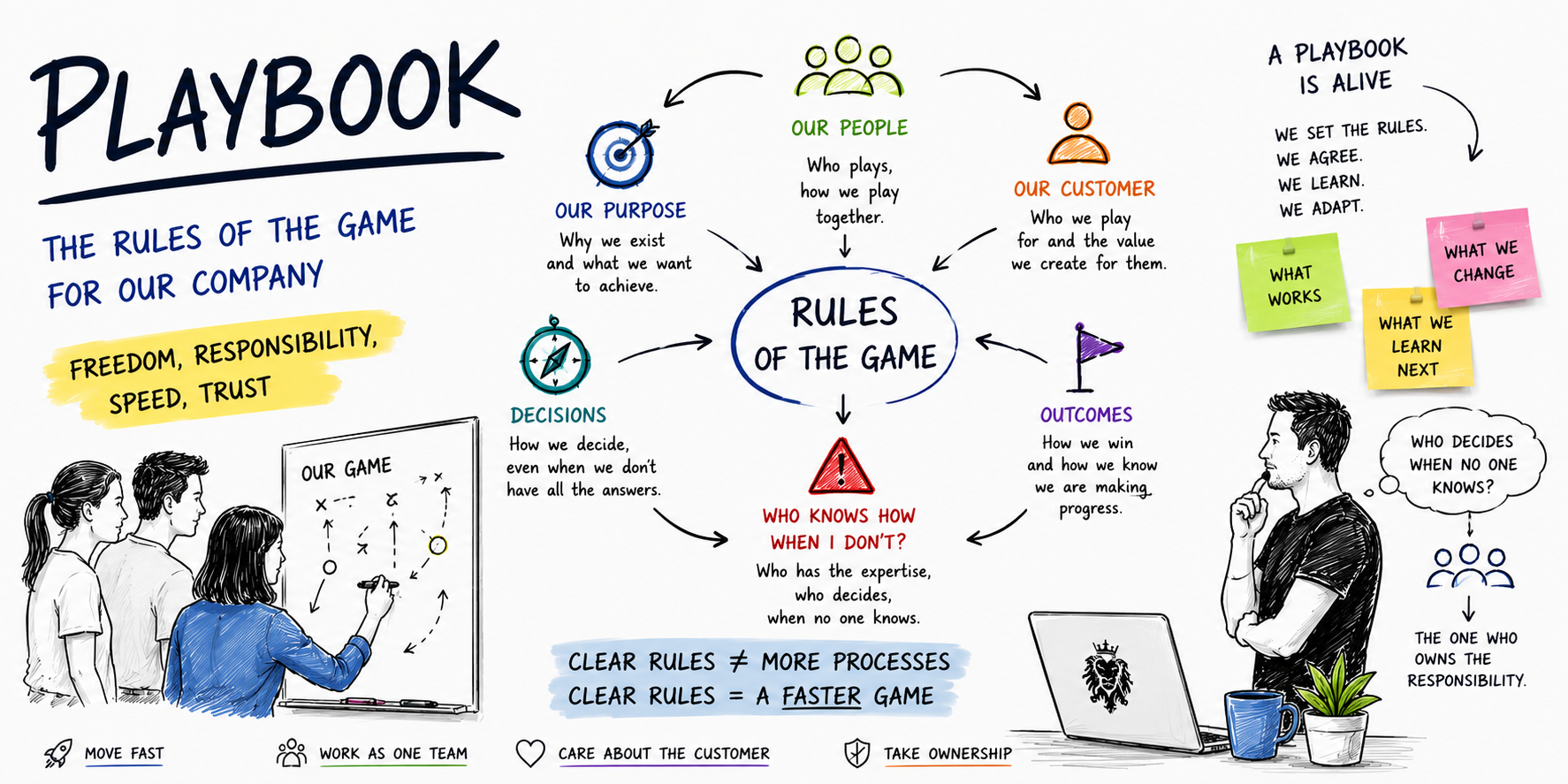
A Business Operations Playbook, Customer Operations Playbook or Sales Ops Playbook is not just another fashionable name for an internal policy.
It is the company’s game book.
It does not merely tell people: “Here is the procedure. Follow it and do not think.”
It says something closer to this:
“This is how we play our game. This is our style. These are the boundaries. These are the typical scenarios. These are the decision rules. These are the tools. These are the instructions you must follow. And this is where we expect your own judgment.”
A playbook is not a weaker form of management. It is a more mature form of management.
It gives the company a shared language, shared logic and shared rules of the game, without trying to lock every step into a procedure.
A process tells people what to do. A playbook teaches them how to play.
A process is useful where there is a clear, repeatable and binding procedure. Accounting, invoicing, occupational safety, data protection, contractual documentation, technical inspections, internal control or any other area where a mistake can create legal, financial, technical or safety risk.
A playbook is useful where reality is not that simple.
And that is almost everywhere in a company.
Sales conversations are not always the same. Customer objections are not always the same. Customer needs are not always the same. Internal cooperation is not always the same. The market changes. People change. Tools change. Priorities change.
Where a rigid process starts getting in the way, a playbook can help.
Not by removing rules. But by creating better rules.
A playbook is not chaos
A playbook does not mean that everyone does whatever they want.
That is a common misunderstanding.
A good playbook contains clear boundaries. It says what is allowed, what is recommended, what is inappropriate and what is forbidden. It shows typical situations and recommended responses. It describes the company’s language, commercial logic, customer style, decision principles, escalation rules and tools.
And where it is truly necessary, the playbook can of course include a precise policy, instruction, checklist or mandatory procedure.
A playbook is not against processes. It simply puts them in the right place.
A process should protect safety.
A playbook should guide the game.
Which processes should remain?
An honest move from a process-heavy organization to a playbook often reveals a surprising fact: you need fewer hard processes than you thought.
The ones that remain are mainly those that protect some form of safety.
Safety should be understood broadly:
legal safety, financial safety, technical safety, cybersecurity, occupational safety, data protection, contractual certainty, reputational safety or customer safety.
In those areas, a precise process makes sense. It is right to have a clear procedure, control, accountability and evidence that the company acted properly.
But wherever the main issue is not safety, it is often better to give people freedom within clearly described boundaries.
A salesperson does not need a script for every sentence. They need to understand whom they are selling to, what the company can truly deliver, what value it creates, where they may improvise and where they must not promise anything without technical or managerial confirmation.
Customer care does not need a script for every unhappy customer. It needs to know how the company thinks about fairness, trust, speed, apology, compensation and escalation.
A manager does not need a spreadsheet for every situation. They need to know the rules of the game — and have the courage to decide.
Sales Ops Playbook: the salesperson as a player, not a CRM operator
A Sales Ops Playbook should not be just a description of the funnel.
A badly designed sales process turns a salesperson into a form operator. It forces them to move opportunities from one stage to another, fill in CRM fields and use phrases that may make sense in a management presentation, but not in a real conversation with a customer.
A good Sales Ops Playbook does something different.
It helps the salesperson play better.
It describes, for example:
- how we recognize a good customer
- when it makes sense to develop an opportunity
- when it is better to politely say no
- what questions must be asked before an offer is made
- how we explain value
- how we work with price
- where a salesperson may improvise
- what must be consulted with technical, legal or senior management
- what a good offer looks like
- what a bad discount looks like
- how a won project is handed over to delivery
Such a playbook does not restrict the salesperson. It gives them solid ground.
They do not have to invent everything from scratch, but they are not stripped of responsibility and judgment.
Customer Operations Playbook: the customer does not see your departments
The customer does not see your organizational chart.
They do not care whether they are currently talking to sales, delivery, support, accounting, a technician or management. They see one company.
And they either feel that the company knows what it is doing, or they feel that people are passing them around like a hot potato.
A Customer Operations Playbook describes how the company takes care of customers in real situations.
- How we hand a customer over from sales to delivery.
- How we communicate delays.
- How we handle complaints.
- When we call instead of writing an email.
- How we explain a technical issue to a non-expert.
- What we never promise.
- How we recognize that a customer is losing trust.
- When a senior person should enter the conversation.
- How we end cooperation respectfully.
A customer playbook is company culture translated into specific situations.
Business Operations Playbook: the spirit of the company in practical form
The broadest layer is the Business Operations Playbook.
It answers one question: how do we do business here?
Not generally. Not as marketing. Practically.
- How do we recognize a priority?
- What does quality mean to us?
- When is speed more important than perfection?
- When must we not speed up?
- How do we work with mistakes?
- How do we escalate a problem?
- How do we make decisions when we do not have all the data?
- How do we use tools?
- What belongs in an email and what belongs in chat?
- What should a document that leaves the company look like?
- How do we behave toward a customer who is wrong?
- How do we behave toward an employee who made a mistake?
- How do we protect margin, trust and reputation?
These questions often disappear in a purely process-driven organization.
Yet they are exactly what determines whether a company feels mature, trustworthy and alive.
A playbook needs leaders
Here comes an important point.
A playbook cannot work in a company where managers expect the document to make decisions for them.
A playbook needs leaders.
Not just process administrators. Not just people who check whether a field was filled in correctly. But managers who understand the game, can play it, can lead it and can also act as referees when necessary.
And sometimes they must take a pencil and rewrite part of the playbook.
- Because the market has changed.
- Because customers respond differently.
- Because a tool that used to work no longer works.
- Because the same mistake keeps repeating.
- Because the team has grown.
- Because a rule no longer helps people, but gets in their way.
Every such change must be communicated to everyone affected by it. Otherwise, the playbook stops being a shared game and becomes a private management document.
A good leader in a playbook company needs four things: knowledge, skills, authority and courage.
Knowledge, so they understand the field, customers, product, people and the economics of decisions.
Skills, so they can communicate, explain, decide, resolve conflict and lead a team without constant command and control.
Authority, so they can make real-time decisions and do not have to send every exception into endless approval chains.
Courage, so they can carry responsibility, admit mistakes, change rules and clearly tell others that from now on this part of the game is played differently.
Without such leaders, a playbook is just a nice document.
With them, it becomes the operating system of the company.
A playbook is not for cowards
At first glance, a playbook may sound softer than process-driven management.
In reality, it requires more courage, not less.
You can hide behind a process. You can hide behind a form. You can hide very comfortably behind the sentence: “That is the procedure.”
A playbook makes that much harder.
It forces people to think, decide, take responsibility, explain their actions and sometimes admit that the rules of the game must change.
That is why a playbook is not for cowards.
But in business, nothing really is.
Business itself is not a safe discipline for people who only want to follow instructions. It is work with uncertainty, people, money, reputation, customers, competition and change.
A playbook does not remove that uncertainty. It simply gives it a better frame.
Instead of false certainty in the form of bloated processes, it offers rules of the game, shared logic, clear boundaries and responsibility.
That is why it can work better.
Not because it is easier.
Because it is more mature.
When to start thinking about a playbook
It makes sense to start thinking about a playbook when you hear any of these sentences in the company:
- „Everyone does it differently.“
- „New people have nowhere to learn this.“
- „We have processes, but nobody uses them.“
- „The customer gets a slightly different answer every time.“
- „Sales promises something different from what delivery provides.“
- „Management has to decide even small things.“
- „When an experienced person leaves, the know-how leaves with them.“
- „We have documentation, but it is not alive.“
- „We are slow, even though everything is described.“
- „People are afraid to decide.“
These are typical signs that the company does not need another process. It needs a shared game.
What the first version of a playbook can look like
The first playbook does not have to be perfect.
On the contrary: if the first version is too ambitious, it will probably never be used.
It is better to start practically.
Choose a few areas where mistakes, misunderstandings or unnecessary escalations keep repeating. Sales. Project handover. Customer communication. Offers. Complaints. Internal communication. Document work.
For each area, ask a few simple questions:
- What game are we actually playing here?
- What is the goal?
- What is a good outcome for us?
- What situations keep repeating?
- Where do people need a precise procedure?
- Where do they need freedom?
- Which mistakes must not happen?
- What decision can a person make alone?
- When must they escalate?
- What communication style do we want to keep?
- What tools do we use?
- What must change so that the customer feels one company?
From these answers, the first real playbook begins to emerge.
Not a document for audit.
A document for the life of the company.
Conclusion: a company does not need more binders. It needs better rules of the game.
Business Operations Playbooks, Customer Operations Playbooks and Sales Ops Playbooks are not fashionable labels for another layer of corporate documentation.
They are a way to capture the operational intelligence of the company.
What otherwise remains in the heads of experienced people.
What new employees learn slowly and painfully.
What customers experience as the company’s style.
What decides whether the company feels professional or random.
A playbook gives the company memory, language and direction.
It does not lock people into a process cage. It gives them rules of the game in which they can play better.
And when a company has leaders with knowledge, skills, authority and courage, it can be managed very well through a playbook.
It can be more flexible for owners.
More meaningful for leaders.
Freer for teams.
And better for customers.
Because in the end, the customer does not know how many processes you have.
The customer knows whether your company knows what it is doing.
Before you call us
Before you call us, try asking one simple question inside your company:
Do we really have a problem with a lack of processes, or are we missing a shared playbook?
You may find that you do not need another form, another control point or another internal policy.
Perhaps you only need to describe the game you have already been playing.
And then start playing it more consciously, faster and with more courage.
And if you are not sure, you can first play a playbook company with us. No major reorganization, no new binders and no process cage. You will simply try what your company could feel like if it had clearer rules of the game, better scenarios and more trust in people.
You may discover that this is exactly what your company has been missing.